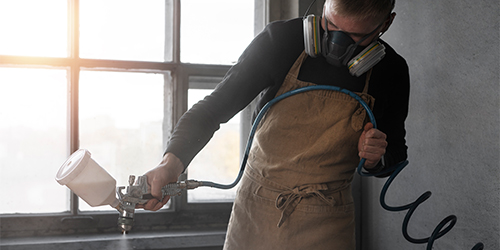
Here’s a simple comparison of their core differences:
Choose Air Spray for a flawless finish on smaller, detailed work where quality is the top priority.
| Feature | Airless Spray Gun | Air Spray Gun (Conventional) |
|---|---|---|
| How it Works | Uses a high-pressure pump to force paint through a tiny tip, which atomizes it. | Uses compressed air (from a compressor) to shatter the paint stream into particles at the nozzle. |
| Pressure Source | High fluid pressure (2000-3000+ PSI). | Compressed air (low pressure, high volume). |
| Speed | Very fast. Ideal for large areas like walls, fences, and exteriors. | Slower. Better for smaller, detailed projects. |
| Finish Quality | Good, efficient coat. Can have a slightly “textured” orange peel effect. | Superior smooth finish. Used for high-gloss automotive, furniture, and fine finishes. |
| Overspray | Moderate to high. Less efficient transfer, more bounce-back. | Very high. A lot of paint gets atomized into the air, requiring more containment. |
| Paint Viscosity | Handles thick materials (latex, elastomerics, stains) directly. | Requires thinned-down materials to be properly atomized by the air. |
| Main Use | Productivity. Large-scale painting, construction, protective coatings. | Precision & Quality. Auto refinishing, cabinets, metalwork, fine woodworking. |
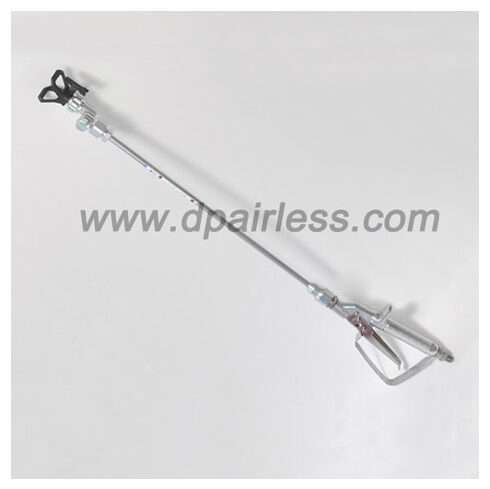
Selecting the right airless spray gun focuses on compatibility, control, and durability. Here’s what to consider:
1. Compatibility with Your Pump
-
Connection Type: Ensure the gun’s hose connection (e.g., M15, M22 thread) matches your sprayer’s hose.
-
Pressure Rating: The gun must be rated for your pump’s maximum pressure (e.g., 3300 PSI, 4500 PSI).
2. Tip Connection & Selection
-
Quick-Connect vs. Threaded: A quick-connect system allows fast tip changes without tools. Standard for most professional work.
-
Tip Compatibility: Choose a gun compatible with standard RAC/X or DuroSpray style tips, giving you a wide range of sizes for different materials and fan widths.
3. Trigger & Control
-
Material: A metal trigger is more durable than plastic.
-
Comfort: A well-balanced gun with a contoured handle reduces fatigue.
-
Safety: A trigger guard and lock prevent accidental spraying.
4. Durability & Material
-
Fluid Path: Look for hardened stainless steel or tungsten carbide internals for longer life, especially with abrasive materials.
-
Body: A robust, metal-body gun is preferred for daily professional use over lightweight plastic models.
5. Special Features (For Specific Needs)
-
Reverse-A-Clean Tip: Allows you to clear a clog by simply rotating the tip, saving time and paint.
-
Extension Poles: For high walls or ceilings, choose a gun compatible with a threaded extension pole.
Quick Decision Guide:
-
For Pros/Heavy Use: Choose a metal-body, quick-connect gun with a reverse tip and a comfortable grip.
-
For DIY/Occasional Use: A quality, contractor-grade gun with a good trigger and standard tip connection is sufficient.
-
Always Match the Tip: The gun is just the holder. Your finish quality depends on selecting the correct tip size (e.g., 0.015″ for stains, 0.021″ for thick latex) for your material.
1. Working Principle
-
Airless: Uses only a very high-pressure pump (2000-4500 PSI) to force material through a tiny tip orifice. The tip alone creates the fan pattern via atomization.
-
Airmix (Air-Assisted Airless): A hybrid system. It uses a high-pressure pump (lower pressure than pure airless, typically 500-1500 PSI) for primary atomization, then adds a low-pressure air stream (5-30 PSI) from an air compressor around the fan to further soften and shape it.
2. Key Comparison
| Feature | Airless Sprayer | Airmix (Air-Assisted Airless) Sprayer |
|---|---|---|
| Atomization | Pure hydraulic pressure. | Pressure + assisted air. |
| Finish Quality | Good, functional coat. Can have more “orange peel.” | Superior, smoother finish. Less texture, finer atomization. |
| Overspray & Bounce-back | Higher. More material is lost to the air and surroundings. | Significantly Lower. The air curtain contains the fan, improving transfer efficiency. |
| Speed | Extremely Fast. Highest material delivery rate. | Fast, but slightly slower than pure airless due to the focused fan. Still much faster than HVLP. |
| Material Usage | Higher consumption due to more overspray. | More Economical. Higher transfer efficiency (more paint lands on the surface). |
| Best For | Large, non-detailed surfaces: Exterior siding, fences, decks, roofs, large walls, protective coatings. | Projects requiring both speed and a fine finish: Cabinets, doors, trim, furniture, commercial interiors, industrial finishes where appearance matters. |
3. How to Choose?
-
Choose Pure Airless if: Your top priority is maximum speed and power for big areas, and the finished texture is not critical (e.g., textured stucco, primer coats, rough siding). It’s the workhorse for volume.
-
Choose Airmix if: You need a high-quality, smooth finish but still have a large area to cover. It bridges the gap between the quality of an HVLP/conventional spray gun and the speed of an airless system. Ideal for fine woodworking, architectural metal, or any production work where reducing sanding and achieving a finer finish is valuable.