
Polyurea is a type of elastomeric polymer created by the instant chemical reaction between an isocyanate component and a resin blend component (amine-terminated). It is known for its extremely fast curing (often gel within 10-30 seconds) and formation of a highly durable, seamless membrane.
Advantages & Disadvantages
| Advantages | Disadvantages |
|---|---|
| 1. Ultra-Fast Cure: Sets in seconds, walkable in minutes. Allows for rapid return to service, high productivity. | 1. Difficult Application: Requires highly skilled, trained operators. The fast cure leaves no time for error in mixing or spray technique. |
| 2. Superior Physical Properties: Exceptional tensile strength, elongation, and tear resistance. More flexible and tougher than many epoxies. | 2. High Equipment Cost: Requires expensive, specialized high-temperature, high-pressure plural-component spray rigs. |
| 3. Excellent Chemical & Water Resistance: Highly resistant to corrosion, chemicals, fuels, and salt water. Forms a seamless, impermeable barrier. | 3. Surface Preparation is Critical: Requires near-white metal blast cleaning (NACE 2/SSPC-SP 10) on steel, and meticulous concrete profiling for optimal adhesion. |
| 4. Thermal Stability & Weathering: Performs well in extreme temperatures (-40°F to 300°F+) and has good UV stability (with aliphatic topcoats). | 4. Moisture Sensitivity: The components are extremely sensitive to moisture. Contamination causes bubbling, pinholes, and coating failure. Strict climate control is needed. |
| 5. 100% Solids, Zero VOCs: Contains no solvents, making it environmentally friendly and safe for confined spaces after curing. | 5. Cost: Material and application costs are significantly higher than epoxies, polyurethanes, or acrylics. |
Polyurea is the premier choice for demanding, high-performance environments:
-
Water & Corrosion Protection: Secondary containment liners (for fuel, chemicals), waterproofing for roofs, decks, balconies, tank linings, pipeline coatings.
-
Industrial & Commercial Flooring: Heavy-duty factory floors, food processing plants, parking garage decks (as a waterproof membrane and wear coat).
-
Transportation: Truck bed liners, marine deck coatings, ballast tank linings, railcar protection.
-
Infrastructure: Bridge protection, tunnel linings, spill containment berms.
-
Specialty: Waterpark and pond liners, theme park set construction, blast mitigation coatings.
Spray Equipment Requirements & Specifications
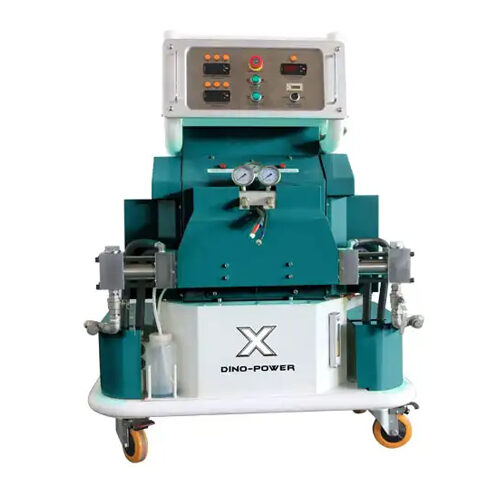
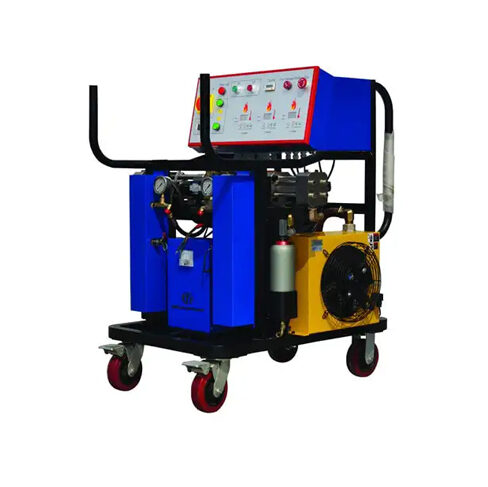
Polyurea MUST be applied with a specialized Plural-Component Spray Machine like our DP-FA65 HXP20 HXP26. A standard airless or even a polyurethane foam rig is insufficient.
Critical Machine Requirements:
-
Proportioning System: Must have two independent, heated piston pumps (or heated gear pumps) to accurately meter the 1:1 volume ratio of Components A and B. Ratio accuracy is non-negotiable.
-
Heated Hoses: Both component lines must be electrically heated hoses (typically to 140-160°F / 60-71°C) to lower material viscosity and ensure perfect laminar flow and mixing.
-
High Pressure & Temperature: The machine must generate high pressure (2,000 – 3,000+ PSI) to force the components through an impedance block static mixer inside the gun for immediate, thorough mixing. Component temperatures must be precisely controlled.
-
Plural-Component Spray Gun: Uses an internal static mixer. Guns are often air-purged to prevent tip clogging between shots.
-
Dew Point Control: Sophisticated rigs include an air dryer/dry-air purge system to keep moisture out of the lines, which is critical for preventing reaction failure.
So Polyurea is a top-tier, high-performance elastomer valued for its speed, toughness, and durability. Its application is a specialized industrial process requiring significant investment in trained labor and high-specification plural-component spray equipment to manage its fast reaction, moisture sensitivity, and achieve its legendary performance.
International Polyurea Brands
The global polyurea market is led by specialized chemical manufacturers and large industrial conglomerates. Here are key international brands, categorized by their market position and origin.
Leading Global & Specialized Brands
| Brand / Company (Origin) | Market Position & Key Characteristics |
|---|---|
| VersaFlex (USA) (Part of Sherwin-Williams) |
One of the most recognized pure-play polyurea brands globally. Known for high-performance formulations, extensive technical support, and a comprehensive product range (pure, hybrid, aliphatic). A go-to for demanding specifications. |
| Polycoat Products (USA) | Major US-based specialist with a strong focus on elastomeric linings, flooring, and roofing systems. Known for robust chemistry and solutions for harsh environments. |
| PPG Industries (USA) | Global coatings giant with significant polyurea offerings under its Protective & Marine Coatings division. Provides system solutions for infrastructure, tanks, and flooring. |
| Rhino Linings (USA) | World’s leading brand in spray-on polyurethane and polyurea truck bed liners. Has a vast global franchise network. Known for durable, abrasion-resistant protective coatings. |
| Kukdo Chemical (South Korea) | Major global producer of polyurethane and polyurea raw materials (isocyanates, polyols, amine-terminated resins). Supplies key components to formulators worldwide, influencing the entire industry. |
| Wanhua Chemical (China) | World’s largest MDI producer (a critical raw material for polyurea/polyurethane). An upstream powerhouse that supplies the global chain. Also has a growing downstream coatings division. |
| Sika (Switzerland) | Global construction chemicals leader. Offers polyurea systems primarily for the construction and waterproofing markets (e.g., roofing, parking decks, joints). Known for system compatibility. |
| BASF (Germany) | World’s largest chemical company. Provides polyurea raw materials and formulated systems (e.g., under its Elastocoat line) for sectors like construction, industrial flooring, and transportation. |
| Futura Coatings (USA) | Specialist in aliphatic polyurea and polyurethane coatings with superior UV stability and color retention. A top choice for architectural, theme park, and decorative applications where aesthetics matter. |
| ArmorThane (USA) | Global supplier of spray equipment, training, and polyurea/polyurethane coatings. Known for a strong distributor and applicator network worldwide, especially in protective linings and recreational surfaces. |
| Nukote / Gaco (USA) | Nukote is a leader in spray-applied pipe rehabilitation liners. Gaco (acquired by GCP Applied Technologies) is a historic brand in elastomeric silicone and polyurea roofing and waterproofing. |
| Supe (Switzerland) (Part of Sika) |
Specialist in spray-applied, fast-cure membranes for roofing and waterproofing. Known for high-performance solutions in the European construction market. |
Key Market Notes:
-
System vs. Raw Materials: Companies like Kukdo and Wanhua are upstream raw material suppliers. Brands like VersaFlex, Rhino, and ArmorThane are formulators/system providers who create the ready-to-spray packaged products.
-
Application Focus:
-
Construction/Waterproofing: Sika, BASF, Gaco, Supe.
-
Industrial Protection/Linings: VersaFlex, PPG, Polycoat.
-
Truck Bed Liners & Recreational: Rhino Linings, ArmorThane.
-
Aesthetic/Architectural: Futura Coatings.
-
Infrastructure Rehabilitation: Nukote.
-
-
Regional Leaders: While the US has a high concentration of leading formulators, European (Sika, BASF) and Asian (Kukdo, Wanhua) companies hold immense influence in raw materials and specific market sectors.
The polyurea market is served by a mix of global chemical titans (BASF, Sika, PPG), specialist formulators (VersaFlex, Futura), and application-focused brands (Rhino Linings, ArmorThane). The choice of brand often depends on the specific application sector (roofing vs. flooring vs. liners), required performance (aromatic vs. aliphatic), and the availability of local technical support and certified applicator networks.
our DP AIRLESS hydraulic-driven polyurea spraying machine could handle these polyurea fluid without problem. because our professional polyurea spray rig consists of three main subsystems:
1. Proportioning Unit (The “Main Frame”)
-
Pump Type: Heated, positive-displacement piston pumps (most common) or gear pumps. Must have two independent pumps for Component A (Iso) and Component B (Resin).
-
Ratio Accuracy: Must maintain a precise 1:1 volumetric ratio (or other specified ratio like 4:1 for some hybrids) with minimal deviation. This is critical for proper cure and performance.
-
Heating System: Integrated electric or fluid-jacketed heaters to maintain component temperatures typically between 140-180°F (60-82°C). Precise temperature control is essential for consistent viscosity and reaction kinetics.
-
Drive System: Hydraulic or electric drive capable of generating high pressure (typically 2,000 – 3,500 PSI).
2. Heated Hoses
-
Construction: Two independent, electrically heated fluid lines running from the proportioner to the spray gun.
-
Function: Maintain the heated temperature of the materials during transport to prevent cooling and viscosity increase, which would disrupt mixing and spray pattern.
3. Plural-Component Spray Gun
-
Mixing Method: Internal Impingement Mixing. The two heated, high-pressure streams collide inside a small, disposable mixing chamber within the gun, ensuring instantaneous, thorough mixing.
-
Air Purge: An automatic air purge function is essential. It clears the mixing chamber after each trigger release to prevent curing material from clogging the gun.
-
Heated Option: High-end guns are also heated for temperature stability at the point of mixing.
and our DP spray pump could generate below data to meet the requirement of the polyurea manufacturer.
| Parameter | Typical Requirement | Why It Matters |
|---|---|---|
| Operating Pressure | 2,000 – 3,500 PSI (138 – 240 bar) | Generates the force needed for proper impingement mixing and material atomization. |
| Maximum Fluid Temperature | Capable of heating to at least 180°F (82°C). | Lowers viscosity for optimal flow, mixing, and spray fan development. |
| Ratio Control | Precision of ±1% or better. | Any ratio drift causes improper cure, leading to sticky, soft, or weak coatings. |
| Output Flow Rate | Varies by project (e.g., 2-20 lb/min or 1-9 kg/min). | Must match the production needs of the application (e.g., thick lining vs. thin coating). |
| Hose Length & Heating | Heated hoses, typically 50-150 ft (15-46 m). | Allows operator mobility on large sites while maintaining material temperature. |