

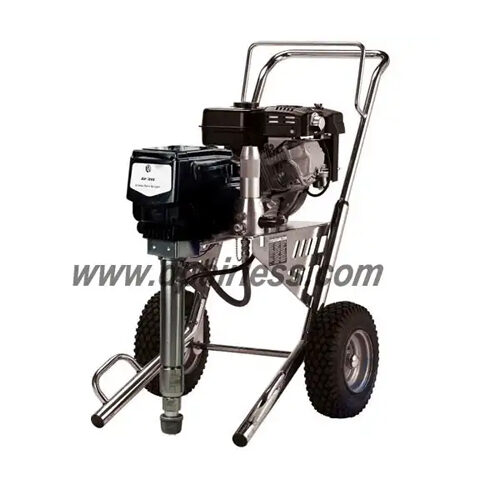

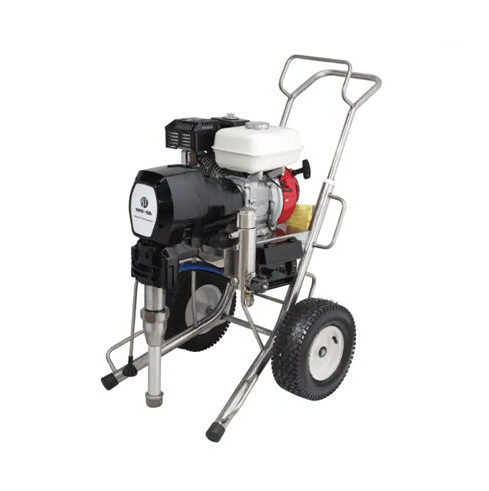
Gas powered airless sprayers are ideal for jobs where electricity is unavailable or impractical. They offer high power, portability, and independence from electrical outlets, making them perfect for large-scale, remote, or outdoor projects. Their robust pumps can handle thicker coatings and provide consistent performance for extended periods, significantly speeding up work on big surfaces like houses, fences, barns, or construction sites.
Key Advantages:
-
Portability & Mobility: No power cords allow free movement around job sites, in fields, or on undeveloped land.
-
High Power & Performance: Typically offer higher pressure and flow rates than many electric models, efficiently spraying thicker materials like latex paints, stains, primers, and elastomeric coatings.
-
No Power Source Needed: Essential for remote locations (e.g., rural properties, agricultural buildings, off-grid sites) or new construction before power is connected.
-
Rugged & Durable: Built for demanding professional use on large, continuous projects.
-
Exterior Residential Painting: Large homes, multi-story houses, siding, stucco.
-
Commercial & Industrial Projects: Warehouses, factories, storage tanks, metal structures.
-
Agricultural & Rural Settings: Barns, fences, outbuildings, sheds far from power sources.
-
New Construction Sites: Where electrical service is not yet available.
-
Large Outdoor Structures: Bridges, fences, pipelines, playground equipment.
-
Thick Coatings & High-Volume Work: Applying heavy latex paints, primers, block fillers, or fire-retardant coatings over vast areas.
Selecting the right gas-powered sprayer involves matching its key features to your specific project needs. Consider these factors:
-
Performance & Pressure: Look at maximum pressure (PSI) and flow rate (GPM). Higher PSI (e.g., 3000-4000+) handles thicker coatings, while higher GPM speeds up large-area coverage.
-
Durability & Components: Check for a reliable commercial-grade engine (e.g., Honda, Briggs & Stratton) and a robust pump frame. Cast iron or hardened steel pumps last longer than aluminum.
-
Portability: Consider weight, wheel type (pneumatic for rough terrain), and hose length. A well-balanced cart is crucial for mobility on job sites.
-
Applications: Match the sprayer to your primary materials (latex, stains, elastomerics) and project scale.


Beyond the standard piston pump, gas sprayers offer specialized pumps for different applications:
-
Standard Piston/Plunger Pump:
-
What it is: The most common type. Uses a piston (plunger) to create high pressure directly on the fluid.
-
Best For: General heavy-duty painting. Excellent for a wide range of coatings, especially high-viscosity materials like thick latex paints, elastomeric roof coatings, heavy primers, and block fillers. It’s the go-to for exterior house painting, commercial buildings, and industrial maintenance.
-
-
Hydraulic Pump:
-
What it is: Uses hydraulic fluid to drive a piston, separating the power system from the paint. Often runs smoother and quieter.
-
Best For: Continuous, high-volume production work and extremely demanding applications. It excels in handling abrasive materials (like zinc-rich primers) and corrosive chemicals better than standard pumps, as the paint only contacts certain parts. Ideal for shipyards, tank linings, and applying industrial protective coatings for long periods without overheating.
-
-
Road Lineing / Striping Pump:
-
What it is: A specialized piston pump designed for very hot (heated) or very cold materials, like thermoplastic road marking paint. It maintains consistent material flow and temperature.
-
Best For: Pavement marking, road striping, and parking lot lines. It handles the unique challenges of melted thermoplastics and reflective glass beads. These units often have built-in material heating systems and precise application guns.
-
