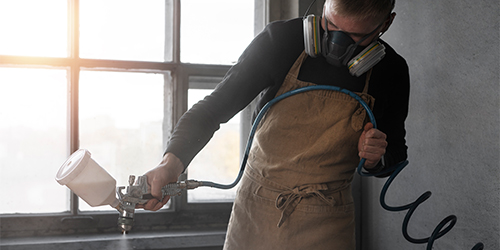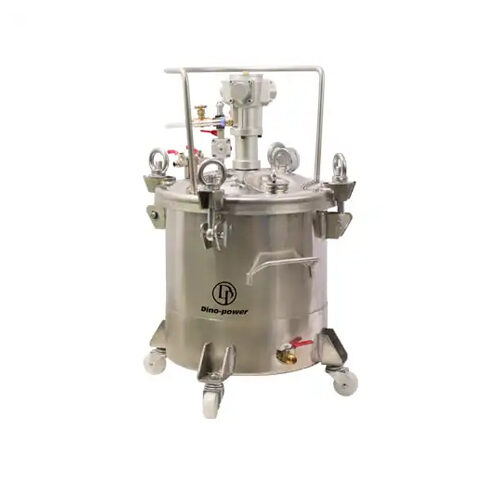

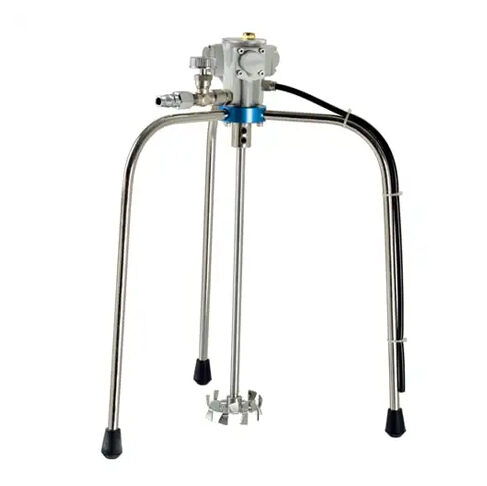
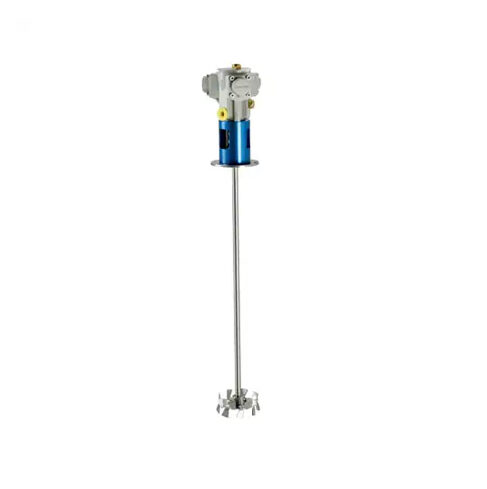
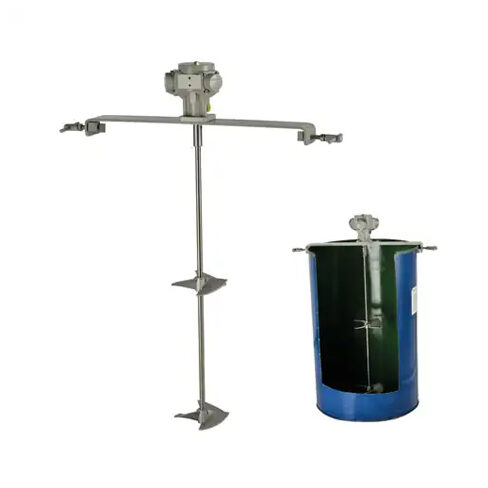


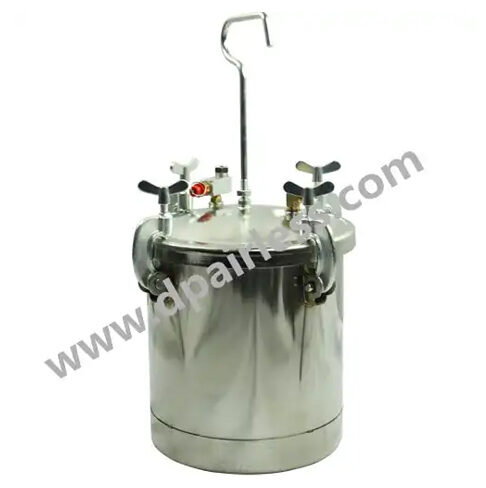
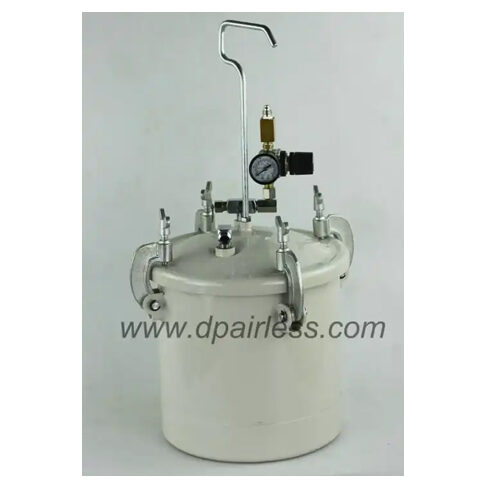
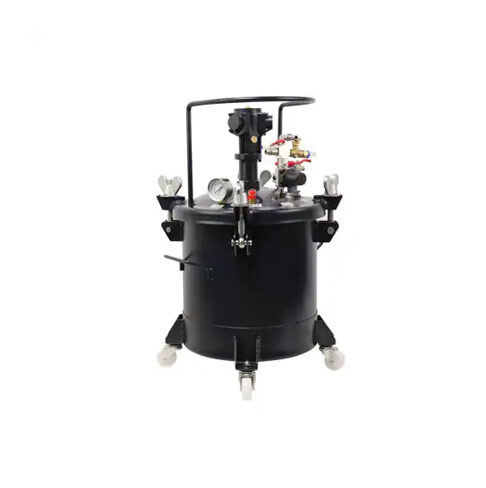
A paint tank, also known as a pressure tank, is a sealed metal container designed to supply coating materials to a spray gun at a consistent flow rate and uniform pressure . It is an essential tool in professional finishing, ensuring that the substrate receives a uniform coat, which helps prevent localized corrosion and equipment failure .
Working Principle
The operation of a pressure tank is based on pneumatic pressure :
-
Pressurization: Compressed air from an external source (air compressor) is fed into the sealed tank .
-
Material Displacement: This air pressure forces the liquid paint to rise through a dip tube and exit the tank via a fluid hose .
-
Atomization: The paint travels to the spray gun. When it reaches the gun head, it meets a separate stream of compressed air, which atomizes the paint into a fine spray .
Pressure pots are available in various sizes, typically ranging from 2 to 60 gallons, (2L, 5L, 10L, 20L, 30L, 40L, 60L) and feature a clamp-on lid, an air pressure regulator, and connections for fluid and air . They can be configured as single-regulated (controlling material flow) or double-regulated (controlling both material flow and atomization air pressure)
The paint tanks could be made in both steel with zinc plated, or stainless steel material. we could customize the paint tank based on clients’ requirement, different color, or feature, or logo / sticker / package.
Pressure tanks are versatile tools suitable for a wide range of paints and applications.
Suitable Paint Types
These tanks are compatible with many coatings, including :
-
Oil based and water-based paints.
-
Metallic paints.
-
Epoxy and resin-based materials (for casting and coating).
-
Industrial finishes.
Ideal Work Scenarios
Pressure pots are preferred in situations where control and finish quality are the primary concerns, rather than just raw speed . Common applications include :
-
Automotive Painting: For high-quality, controlled finishes.
-
Industrial and Marine Coating: Painting construction vehicles, machinery, and ships.
-
Architectural Details: Ideal for home decor, walls, fences, and intricate woodwork where precision is required.
-
High-Solids & Specialty Materials: Excellent for feeding HVLP or LVMP spray guns with thicker, high-performance materials .
-
Resin Crafting: Used as a resin casting pot for creating crafts
How to Use a pressure tank?
-
Fill the Tank: Pour the prepared, strained paint into the tank .
-
Seal the Lid: Securely close the lid using the clamps or thumb screws .
-
Connect Hoses: Attach the air hose from the compressor to the tank’s air inlet, and connect the fluid hose to the spray gun.
-
Adjust Pressure: Turn on the air supply. Use the T-handle on the tank’s regulator to increase pressure (maximum 3bar 43.5psi) while pulling the gun trigger until the desired material flow is achieved . Atomization air is adjusted at the gun or a secondary regulator


Immediate and thorough cleaning after each use prevents hardened paint from ruining the equipment .
-
Relieve Pressure: Turn off the main air supply and turn the regulator T-handle counter-clockwise to release spring tension .
-
Back-Flush (Optional): To clear the hose, loosen the gun’s air cap, hold a cloth over it, and pull the trigger. Air pressure will force material back into the tank .
-
Empty Residue: Open the tank lid and pour out any leftover paint .
-
Solvent Flush: Pour a small amount of compatible solvent or thinner into the tank, reseal it, and apply low air pressure. Spray the solvent through the hose and gun until it runs clear .
-
Wipe Down: Wipe all components with a cloth moistened with solvent
Critical Safety Precautions
-
Never Modify the Tank: Do not drill into or alter the tank, as this can weaken it dangerously .
- Never set the pressure higher than the maximum pressure which is normally 2 or 3 bar (sticked or printed on the tank lid)
-
Respect the Safety Valve: Do not adjust or tamper with the safety valve. It is set to prevent over-pressurization .
-
Check Chemical Compatibility: Do not use acids, caustic solutions, or halogenated hydrocarbon solvents, as they can corrode the lid gasket and safety valve seal .
-
Avoid Caustic Cleaners: Never use lye or caustic-alkali solutions for cleaning, as they can damage the equipment .
Maintenance Tips
-
Regular Cleaning: Ensure all ports and passages are free of hardened paint that could interfere with air movement .
-
Deep Cleaning: If passages become clogged, disassemble metal parts and soak them in thinner. Use a soft wire to gently clear passages if necessary .
-
Lubrication: For long-term storage, coat moving parts with a thin film of oil to prevent rust .
-
Inspect Seals: Regularly check the lid gasket and seals for wear and tear to prevent leaks.
Choosing between a pressure pot and an airless sprayer depends on your project priorities: control vs. speed .
| Feature | Pressure Pot (with HVLP/LVMP Gun) | Airless Sprayer |
|---|---|---|
| How it Works | Uses air pressure in the tank to feed a spray gun. Atomization occurs via separate air at the gun . | Uses a high-pressure piston pump (1500-3,000 psi) to force paint through a tiny tip, atomizing it without compressed air . |
| Pros | • Superior Control: Independent regulation of fluid and atomization air . • Higher Transfer Efficiency: Uses less coating compared to airless, saving material . • Better Finish: Ideal for precision and high-quality specifications . • Easier Cleanup: Requires less solvent . |
• Extremely Fast: High production rates for large areas . • High Volume: Supplies high volumes of coating quickly . • Handles Viscous Materials: Can spray thicker coatings directly . • Portability: May not require a separate air compressor . |
| Cons | • Slower Speed: Not as fast as airless for large-scale coverage . • Requires Compressor: Needs a separate, powerful air source. • Big bounce back of the atomized paint |
• Less Control: Loses independent control of fluid and atomization . • Lower Efficiency: More overspray and material waste compared to HVLP . • Safety Hazard: High pressure poses a serious skin injection danger |