
How Does the Plastering Machine and Spray Lance Technology Work?
A plastering machine transports a compatible plaster or mortar through a hose; the spray lance controls where and how that material reaches the wall. On many mortar systems, compressed air at the lance distributes the material through the spray nozzle of 10/12/14mm diameter. That differs from an airless paint sprayer, which atomises a coating through a small high-pressure tip which is only 0.3 – 0.5mm.
Follow the material through the Plastering Machine system
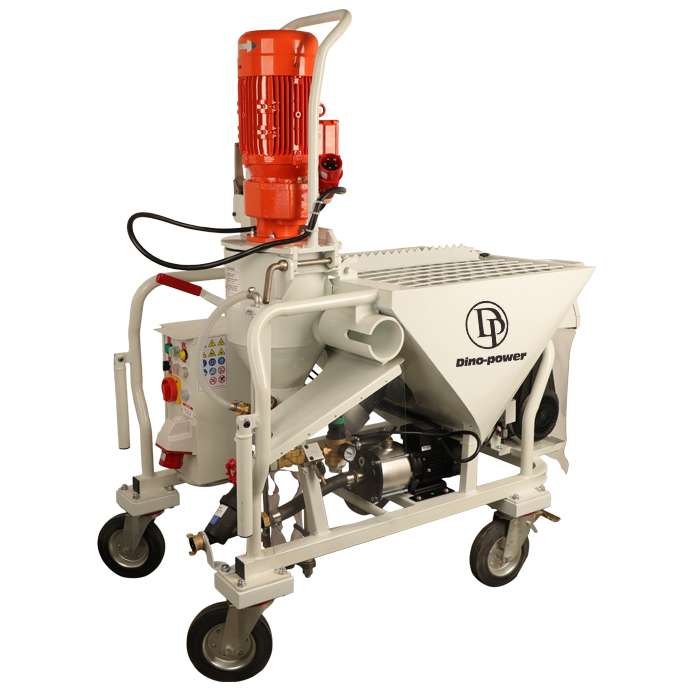
- Mixing: DP-M6 use a continuous mixing pump combines a specified dry mix with metered water. A delivery-only pump instead receives material mixed separately. Not every plastering machine mixes dry powder, but we DP offer the range of rotor stator pump with or without mixer.
- Pumping: the pump moves the prepared material into a pressure-rated delivery hose. Rotor/stator systems are common, but pump design and allowable aggregate size vary. different rotor / stator size (diameter and length) could generate different spraying capacity and pressure.
- Delivery: hose diameter, length, vertical rise and material consistency affect the load. A quoted maximum horizontal reach does not establish an equivalent vertical reach.
- Spraying: the lance brings together material flow and, where required, compressed air. The nozzle, output and air supply need to match the specified mix and intended texture.
Which materials can be used by Plastering Machine?
Choose machine-grade products approved by the material supplier for the exact equipment type. Gypsum plaster, cement render, premixed filler and decorative texture are not interchangeable. Check maximum grain size, water demand, working time, hose requirements and cleaning method. An ordinary airless paint spray tip is unsuitable for coarse mortar because it contains grains inside which will block the nozzle quickly.
DP-M6 can spray the dry premixed materials:
- Gypsum Plaster / Lime Plaster / Cement Render / Joint Compound
- Structural Repair Mortar / Concrete Repair Mortar / Structural Grout
- Structural Plaster / Structural Render / Heavy-duty Render
- Restoration Plaster / Historic Lime Plaster / NHL Mortar / Heritage Plaster
- Stucco / Exterior Render / Traditional Stucco
- Injection Grout / Masonry Injection Mortar / Epoxy Injection Resin
- Core-Fill Grout / Masonry Grout / Non-Shrink Grout
- ETICS Adhesive / EIFS Adhesive / Base Coat / Insulation Board Glue
- Thermal Insulating Screed / Lightweight Screed / Cork or Polystyrene Screed
- Insulating Render / Thermal Plaster / Warm Render
- SFRM (Spray-Applied Fireproofing) / Fireproofing Mortar / Passive Fire Protection Mortar
- Self-Leveling Underlayment (SLU) / Self-Leveling Compound / Floor Self-Leveler
- Liquid Screed / Calcium Sulphate Screed / Gypsum Self-Leveler
By the way, Too little water can increase resistance and cause poor delivery; too much can reduce the finished material’s performance. Set water addition from the product instructions and verify consistency on site. Do not thin simply until the machine can move the material.
Set up the lance for even coverage
Prepare the substrate, protect adjacent surfaces and confirm suitable temperature and absorption conditions. Prime or lubricate the hose only by the approved method. Establish stable delivery before working on the finished surface. Use a test area to set output, nozzle and air supply, then hold a consistent distance and move at a steady speed.
The machine applies material; it does not automatically produce a level, finished wall. Screeding, levelling, finishing and curing may still be necessary. An extension also does not remove the need for safe access equipment or a jobsite assessment.
Diagnose the symptom before adjusting pressure
| Symptom | Checks |
|---|---|
| Pulsing or uneven discharge | Material supply, mix consistency, pump wear and air delivery |
| Poor texture or excessive bounce | Nozzle choice, air adjustment, distance and substrate |
| Reduced delivery or blockage | Hose route, setting material, aggregate size and pump condition |
Stop and follow the manufacturer’s blockage and pressure-relief procedure before disconnecting a hose. Never loosen a coupling to release a pressurised blockage. Clean promptly within the material’s working time.
Related guides
- How to spay putty / plaster with airless paint sprayer?
- Which kind of machine can spray fireproofing coating?
For equipment selection, specify the material name, grain size, required delivery rate, hose route and available power and air supply. This gives a more useful starting point than selecting a machine by motor power alone.
