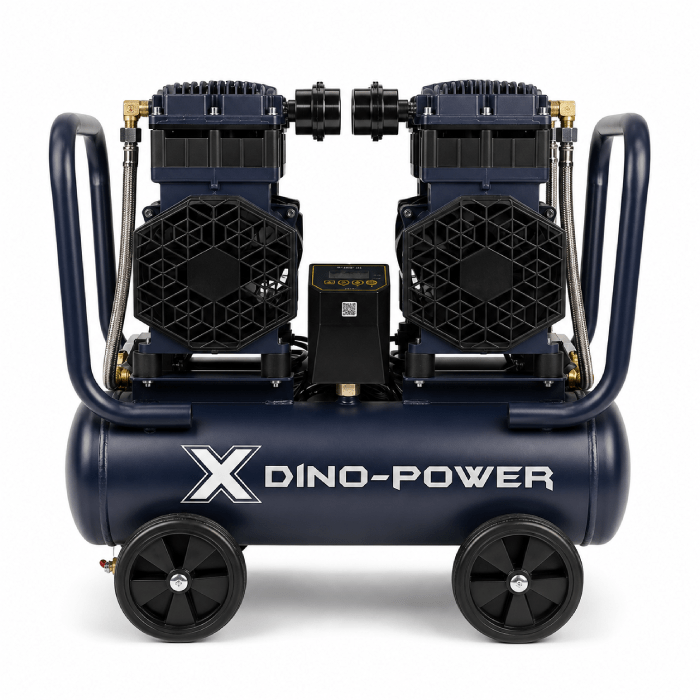
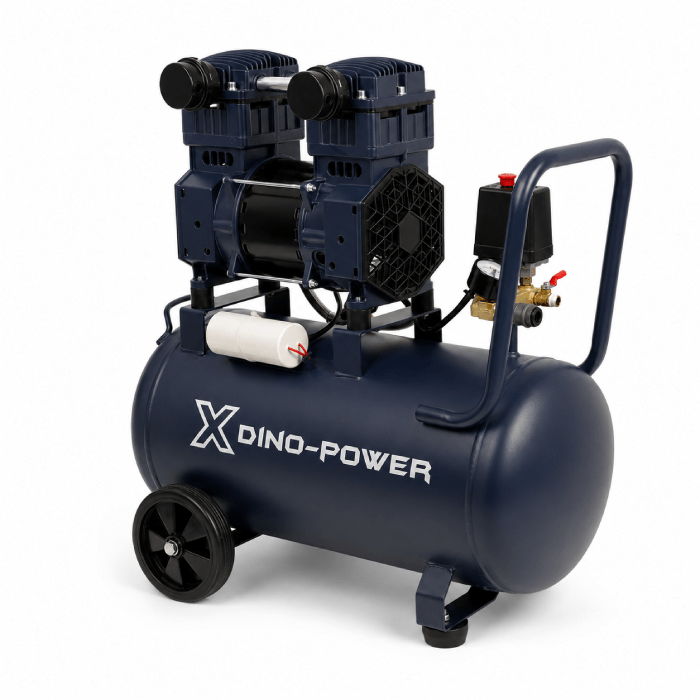
motor-power 2680W*2
Rated Speed 2800rpm
Air Tank Capacity 40L

Motor power 5000W
Max. tip size 0.045”
Flow rate 8.5L/min




How to Apply Putty Material? Methods for Spraying Putty
Applying putty or filler material via spray is a specialized industrial process for high-volume application. The key is using equipment that can handle high-viscosity, abrasive, and quick-setting materials.
Corrected Spray Application Methods for Putty
1. Airless Spray with Heavy-Build Tips & Agitator (For Water-Based/Light Compounds)
-
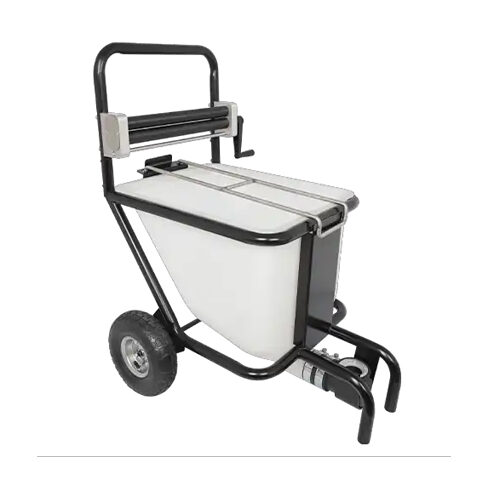
Process & Equipment: Uses a heavy-duty airless sprayer such as X51, X81, T60, T85 OR hydraulic pump sprayer DP-9600E , and better be equipped with a continuous agitator in the pressure pot/hopper and a large-orifice, heavy-build tip (e.g., .031” – .043”). The material must be pre-mixed to a sprayable consistency.
-
Best For: High-volume application of water-based joint compounds (for drywall), some acrylic-based fillers, and light texture materials.
-
Limitation: Not suitable for highly viscous two-part polyester/ epoxy putties or materials with extremely high solids content.
2. Screw Pump (Rotor Stator System)
-
Process & Equipment: A screw pump (also called a progressive cavity pump) uses a rotating screw within a stator to positively displace thick, paste-like material at a consistent rate without high shear forces. it normally generate high pressure to atomize it onto the wall.
-
How It Works:
-
The pump draws material directly from a drum or cartridge.
-
For two-part materials, two synchronized screw pumps meter the resin and hardener in a precise ratio.
-
The components are then fed into a static mixer tube attached to the spray gun.
-
3. Texture/Hopper Gun with Air Compressor (For Specific Textures)
-
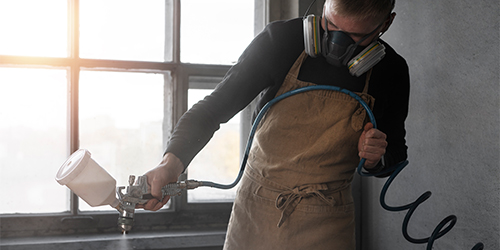
Process & Equipment: A hopper gun uses compressed air to propel and atomize material fed by gravity from a top-mounted hopper.
-
Best For: Applying “popcorn” ceiling texture, stucco patching compounds, and other coarse, thick-textured finishes. It is not for achieving smooth, trowel-ready surfaces
A plastering machine (also called a rendering machine, mortar sprayer, or stucco pump) is a specialized construction tool designed to automate the mixing, pumping, and application of plaster, render, cement-based mortars, and similar viscous materials onto walls, ceilings, and floors. It replaces the labor-intensive manual processes of hand-mixing and hawk-and-trowel application with a continuous, high-output system.
How Does It Work?
A typical plastering machine integrates three functions:
-
Continuous Mixing: Dry pre-mix or separate components (cement, sand, additives) and water are fed into the machine’s mixing chamber or hopper. A rotating paddle or auger blends them into a consistent, lump-free wet mortar.
-
Pumping: The wet mix is transferred to a positive-displacement pump. The most common types are:
-
Rotary Screw Pump (Progressive Cavity Pump): Ideal for smooth, continuous flow of standard plaster and render.
-
Piston Pump: Used for higher-pressure applications and thicker materials like sprayed concrete.
-
Peristaltic Pump: Common in smaller machines, suitable for fine finishes.
-
-
Spray Application: The pumped material is forced through a hose to a spray gun. At the gun, compressed air is often introduced to shape and accelerate the material stream, projecting it onto the surface in a controlled layer.
Phase 1: Setup & Preparation
-
Site & Machine Setup: Position the machine on stable, level ground near a power source, water supply, and material stockpile. Connect the air compressor (if required for the gun).
-
Material Loading: Load the hopper with the dry pre-mix plaster or connect the sand/cement silos and water lines as per the machine’s design. Never put already mixed wet plaster into the hopper of most machines.
-
Hose & Gun Assembly: Connect the material hose and air line to the spray gun. Ensure all connections are secure.
-
Test Run & Adjustment: Run the machine with water or a small batch of material to calibrate the water-to-mix ratio and adjust the air pressure at the gun. This is critical for achieving the correct material consistency and spray pattern.
Phase 2: Application
-
Surface Preparation: The wall must be clean, structurally sound, and often primed or dampened (for masonry) to ensure proper adhesion and control suction.
-
Spray Technique:
-
Hold the spray gun perpendicular to the wall at a consistent distance (typically 30-60 cm or 1-2 feet).
-
Use smooth, overlapping horizontal or vertical passes to build up an even layer. Start from the bottom and work upwards for walls.
-
The goal is to apply a uniform, slightly over-thick coat that fully covers the surface.
-
-
Immediate Screeding & Finishing: The sprayed material must be worked immediately. While it is still fresh, use a H-frame, straight edge, or darby to screed the surface to the desired flatness and thickness. Final smoothing is then done with a trowel or float.
Phase 3: Cleanup
-
Flush the System: After use, immediately run clean water through the machine’s mixing chamber, pump, and hoses until the discharge runs clear. Any leftover material that hardens inside will damage the machine.
-
Disassemble & Clean: Fully clean the hopper, spray gun, and all tools with water before the material sets.
Key Advantages of Using a Plastering Machine
-
Speed: Applies material 5-10 times faster than manual methods.
-
Consistency: Delivers a uniform mix and consistent application thickness.
-
Labor Savings: Reduces physical fatigue and requires a smaller crew.
-
Improved Adhesion: The spray force provides excellent mechanical bonding to the substrate.
-
Versatility: Can handle a range of materials from fine interior plasters to coarse exterior renders


The market is led by major global brands, with strong regional contenders offering compelling value. Here’s a simplified overview.
Major International & Regional Brands
| Brand (Country) | Core Technology & Market Focus | Key Differentiators |
|---|---|---|
| PFT (Germany) (Part of SAMES KREMLIN) |
High-Precision Mixing & Pumping. The industry benchmark for professional plastering and rendering. | • Revolutionary “Turbomixer”: Perfectly homogeneous, air-entrained mix, crucial for finish quality. • Modular System: Highly compatible and scalable components. • Extensive Range: From compact units to large-scale rotor pumps (G4, G5). • Strongest Global Dealer/Service Network for plastering. |
| M-TEC (Germany) (Part of Maxit Group) |
Robust Innovation & Complete Solutions. Focus on productivity, ease of use, and system solutions. | • Duomix / Duomatic Technology: Advanced continuous mixing with precise digital water dosing. • Smart Control Systems for consistent output. • Strong Focus on Lightweight Insulating Plasters (EPS) and EIFS/ETICS. • Excellent for renovation and complete facade systems. |
| KNAUF (Germany) | Complete System Provider. Machines optimized for Knauf’s own premixed bagged products. | • “Perfect Match” Philosophy: Machine and material engineered together. • User-Friendly & Reliable: Simplified, rugged design for daily site use. • Global Brand Leverage: Benefits from vast building materials distribution. |
| PUTZMEISTER (Germany) | Extreme Power & Versatility. Heavy-duty mortar and plaster machines from a concrete pump leader. | • Rotary Piston Pumps (SVM): Exceptional power for long-distance/high-vertical pumping. • Durability: Built for the toughest, largest-scale projects. • Best for extreme output or pumping over long distances/up many floors. |
| IMER (Italy) | Value & Practicality. Wide range of competitive, reliable machines for general contractors. | • Broad Product Portfolio: From small hopper guns to rendering stations. • Good Price-to-Performance Ratio: Popular with mid-sized companies. • Solid workhorses for standard rendering and plastering. |
| DINO-POWER (China) | High-Value Performance. Professional-grade machines offering premium configurations at competitive cost. (Model: Plastering Machine M6) | • Hybrid Component Strategy: Utilizes imported core components (e.g., Rotor Stator, Compressor, Water Pump) for reliability, with options for domestic configuration parts for cost flexibility. • Proven Performance: Widely sold and highly praised for consistent, high-quality output comparable to premium brands. • Key Advantage: Delivers high-end quality and durability with significantly better cost-effectiveness . A top-tier choice for professionals seeking maximum return on investment without compromising on core performance. |
Summary of Key Differences & How to Choose
The differences boil down to core philosophy, technology, and target market:
-
Mixing Technology & Core Components:
-
PFT (Turbomixer): Focus on perfect mix quality.
-
M-TEC (Duomix): Focus on precise digital control.
-
DINO-POWER (M6): Focus on proven, high-quality imported core components ensuring reliable performance, with a flexible build strategy.
-
Others: Reliable paddle or screw mixing.
-
-
Pump Technology & Power:
-
Putzmeister (Rotary Piston): Power and distance champions.
-
PFT / DINO-POWER / Others (Rotor/Screw Pumps): Smooth, continuous flow ideal for standard and finish plaster application.
-
-
Value Proposition & Market Position:
-
Premium Benchmark (Technology/Network): PFT, M-TEC.
-
System-Optimized: Knauf.
-
Extreme Power/Scalability: Putzmeister.
-
High-Value Performance: DINO-POWER. This brand successfully bridges the gap between top-tier performance and accessible investment, making professional-grade results achievable for a broader range of contractors.
-
-
Project Scale & Specialty:
-
Large-Scale / Industrial / Long-Distance: Putzmeister, PFT large units.
-
General Plastering/Rendering (Quality & Value Focus): PFT, DINO-POWER, M-TEC.
-
Lightweight/EPS Plasters & EIFS: M-TEC has a strong edge.
-
Value & General Contracting: IMER, DINO-POWER.
-
Choosing a Brand: The “Best Fit” Principle
The decision is not about a universal “best” but the best fit for your business needs, project types, and budget.
-
For a specialist plastering contractor where finish quality is paramount and budget is secondary: PFT remains a top default.
-
For a contractor focused on insulated facade systems (EIFS): M-TEC is a leader.
-
For a large contractor needing to pump material 30+ floors: Putzmeister is essential.
-
For a professional contractor seeking the optimal balance of proven high-end performance, durability, and cost-effectiveness : DINO-POWER (M6) represents a strategically excellent choice, especially in markets where value engineering is critical.
So The most successful application comes from the trinity of Machine, Material, and Skilled Operator. Before deciding, test the machine with your typical materials, evaluate local dealer support, and carefully consider your total cost of ownership. Brands like DINO-POWER demonstrate that premium results are achievable through intelligent engineering and component selection, offering a powerful alternative in the global market.
Plastering (rendering/spraying) machines and their compatible materials form a specialized global ecosystem, concentrated in regions where efficiency, quality, and labor costs drive the adoption of mechanized construction.
Primary Markets
-
Europe – The Largest & Most Mature Market
-
Germany, Austria, Switzerland (D-A-CH Region): The core market and technological birthplace. Machine-applied plaster and render is the standard, driven by high labor costs, stringent quality requirements, and a massive renovation sector (external insulation systems).
-
UK, France, Benelux, Scandinavia: Highly developed markets. Widespread use for gypsum plasters, insulating renders (ETICS/EIFS), and floor screeds.
-
Eastern Europe (Poland, Russia, etc.): Rapidly growing market. Mechanization is accelerating due to rising labor costs and adoption of Western construction standards.
-
-
Asia-Pacific – The High-Growth Core Market
-
China: The world’s largest and fastest-growing single market. Driven by massive infrastructure/real estate projects, government promotion of prefabrication and green building, and rising labor costs. High demand for cost-effective and locally adapted machines.
-
Australia & New Zealand: Strong, established market. Popular for both interior plastering and exterior acrylic/textured renders due to specific climatic conditions and construction styles.
-
Southeast Asia (e.g., Singapore, Malaysia): Growing niche market. Primarily for high-end projects and specialized applications like waterproofing renders.
-
-
North America – A Specialized Market
-
United States & Canada: Market is more specialized and fragmented. Heavy use of drywall limits traditional wet plaster. Machines are dominant in:
-
Exterior Insulation and Finish Systems (EIFS)
-
Stucco application (cement-based plaster)
-
Fireproofing and acoustic spray materials
-
Specialty veneer plasters and floor underlayments.
-
-
-
Middle East – Project-Driven Market
-
GCC Countries (UAE, Saudi Arabia, Qatar): Major project-based market. High consumption for interior and exterior finishes in large-scale commercial, hospitality, and infrastructure projects. Demand is for high-output, durable machines.
-
Welcome to be our DINO-POWER dealer in all these countries.
we’ll offer premium quality machine and fast delivery / positive service to meet your requirement.
We DP have full range of rotor stator pump for different application, from putty texture plaster EPS to concrete, shotcrete, selfleveling etc.
Major Global & Regional Material Brands
The material brands are often tied to the machine manufacturers or are large chemical/building material conglomerates.
| Region | Primary Material Types | Leading Material Brands (Examples) |
|---|---|---|
| Europe | Gypsum Plasters, Lime-Cement Renders, Insulating Renders (EPS/Mineral Wool), Machine-Made Floor Screeds. | Knauf, Saint-Gobain (Weber, Siniat), Baumit, M-TEC (Maxit), Henkel (Ceresit), Parex, Caparol, Bostik. |
| North America | EIFS/Stucco Finishes, Acrylic/Polymer-Based Renders, Veneer Plasters, Spray Fireproofing. | STO, Dryvit, ParexUSA, Senergy, BASF (MasterSeal), GCP Applied Technologies, USG, Grace. |
| Asia-Pacific | Cement-Based Waterproof Renders, Gypsum Plasters, Tile Adhesives, Insulating & Decorative Renders. | China: Mapei, Sika, Weber (Saint-Gobain), Yuhong, Carpoly. Regional: Bostik, Ardex, KNAUF Asia. |
| Global (Chemicals) | Additives, Redispersible Polymers, Admixtures (for high-performance custom mixes). | BASF, Wacker, Dow, Ashland, Shin-Etsu. |
Key Relationship: Machine & Material System
-
Closed Systems: Some manufacturers, like Knauf and M-TEC/Maxit, heavily promote optimized compatibility between their machines and their own bagged pre-mix materials, ensuring guaranteed performance.
-
Open Systems: Brands like PFT and DINO-POWER produce high-performance machines designed to work reliably with a wide array of materials from different suppliers, offering contractors greater flexibility.
Market Driver: The plastering machine market thrives where there is a confluence of high labor costs, demand for speed/quality, and the prevalence of wet construction methods (masonry, concrete) or specialized exterior insulation systems. The Asia-Pacific region, led by China, is the current growth engine, while Europe remains the technology and quality benchmark